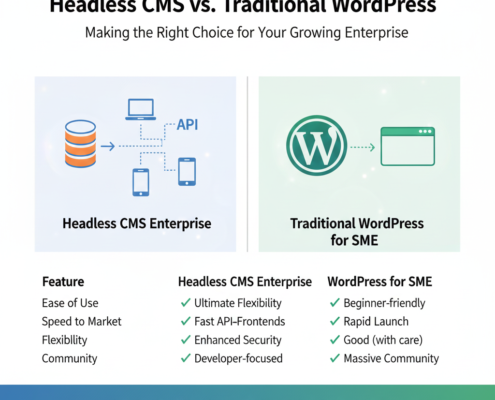
Headless CMS vs. Traditional WordPress: Making the Right Choice for Your Growing Enterprise

For high-growth US startups and UK scale-ups, choosing the right Content Management System (CMS) is a critical decision. It’s not just about managing content today, but about future-proofing your digital infrastructure for speed, security, and scalability.

While Traditional WordPress has powered millions of websites for years, the rise of Headless CMS has presented a compelling alternative for enterprises looking to shed “bloat” and embrace true digital flexibility. But which path is right for your organization’s ambitions?

The Traditional WordPress Advantage: Simplicity & Speed for SMBs

For Small to Medium-sized Businesses (SMBs) and many startups, Traditional WordPress remains an excellent choice, and for good reason:

  • All-in-One Solution: WordPress is a monolithic system. The backend (where you manage content) and frontend (what users see) are tightly coupled. This means less setup time.
  • Ease of Use & Community: Its intuitive admin panel and vast ecosystem of themes and plugins make it easy for non-technical users to launch and manage a site quickly.
  • Cost-Effective: Often more affordable for initial setup and maintenance, especially for smaller businesses with limited developer resources.
  • Rapid Deployment: You can get a professional-looking website live fast, ideal for testing ideas or establishing an initial online presence.

However, as a business scales, this simplicity can become its Achilles’ heel.

The Headless CMS Revolution: Agility for Enterprise Growth

A Headless CMS separates the content management backend (the “head”) from the presentation layer (the “body” or frontend). Your content is stored and managed, but delivered via APIs to any frontend you choose – be it a website, mobile app, smart device, or IoT product.

This architectural shift brings significant advantages for growing enterprises:

1. Unmatched Flexibility & Future-Proofing:

  • “Content Anywhere”: Deliver your content to multiple platforms and devices simultaneously from a single source. This is crucial for omnichannel marketing strategies.
  • Frontend Freedom: Your developers can use cutting-edge frameworks (React, Vue, Next.js, Gatsby) for the frontend, optimizing for speed and custom user experiences without CMS limitations.
  • API-First Approach: Integrates seamlessly with other business systems (CRM, ERP, e-commerce platforms) via APIs, creating a truly connected digital ecosystem.

2.Superior Performance & Scalability:

  • By decoupling the frontend, Headless setups often achieve lightning-fast load times, crucial for Core Web Vitals and user retention (especially in the impatient US/UK markets).
  • They handle high traffic volumes more efficiently, scaling resources for content and presentation independently.

3. Enhanced Security:

  • Separating the frontend from the content database significantly reduces attack vectors, as the database isn’t directly exposed to public web requests.

4. Developer Experience:

  • Empowers development teams to use their preferred tools and languages, fostering innovation and attracting top talent.

The Enterprise Choice: Where WordPress Hits Its Limits

For UK scale-ups and US enterprises focused on rapid innovation and digital agility, Traditional WordPress can introduce challenges:

  • Performance Bottlenecks: Heavy plugins and themes can lead to slow loading times, impacting SEO and user experience.
  • Security Concerns: Its popularity makes it a frequent target for hackers, requiring constant vigilance with plugin and core updates.
  • Limited Customization for Complex Needs: Deep integrations and highly custom user interfaces can be cumbersome and costly to build within a monolithic WordPress structure.
  • Scaling Challenges: Managing content across multiple complex digital properties can become difficult as the business expands.

Making the Right Choice for Your Business

The decision between a Headless CMS and Traditional WordPress boils down to your business goals, current scale, budget, and internal technical capabilities.

  • Traditional WordPress is still ideal for: Small businesses, blogs, brochure websites, and companies needing a fast, cost-effective launch with a simple content structure.
  • Headless CMS is the future for: High-growth enterprises, e-commerce platforms, companies with complex content distribution needs (apps, IoT), and those prioritizing cutting-edge performance, security, and developer flexibility.

Don’t let an outdated CMS stifle your growth. Understanding your options is the first step towards building a digital foundation that truly empowers your enterprise’s ambitions in the UK and USA.

Unsure which is the right path for your business? Contact us today for a consultation to evaluate your current tech stack and future growth potential.

Related Post

5 Common E-Commerce Checkout Problems

In the competitive world of US online retail, the journey from "Add to Cart" to "Order Confirmed" is where most sales are won or lost. Statistics show that the average cart abandonment rate in

Best Lightweight WordPress Themes for Lead Generation 2026

Is your WordPress website getting traffic, but not generating leads or sales? You're not alone. Many small business owners invest in a beautiful website.However, they soon

SEO is Shifting to GEO: How to Rank in Google’s AI Overviews and Perplexity in 2025

The search landscape is undergoing its most significant transformation in decades. For US and UK marketing managers, the burning question..

How AI-Powered Chatbots are Saving UK Small Businesses £10k+ in Annual Support Costs

The search landscape is undergoing its most significant transformation in decades. For US and UK marketing managers, the burning question..
flatsome

Maximize Your E-commerce Sales: Why You Need a Flatsome Theme Expert in 2026

If you're running a WooCommerce store, you know that speed and design are non-negotiable for success. The Flatsome Theme by UX Themes

Why Your Business Needs a Certified Gravity Forms Expert in 2026

Are you struggling to build complex forms that actually convert? While WordPress makes it easy to start, creating high-level automation requires a Gravity Forms expert

Headless CMS vs. Traditional WordPress: Making the Right Choice for Your Growing Enterprise

For high-growth US startups and UK scale-ups, choosing the right Content Management System (CMS) is a critical decision.

The 2.5-Second Rule: Why UK & US Consumers Abandon Slow Sites and How to Fix Your Core Web Vitals

Google's Core Web Vitals (CWV) are more than just technical metrics; they are a direct measure of your site's user experience.

Is Your Tech Stack GDPR & CCPA Ready? Why Compliance is the New Competitive Advantage

with great data comes great responsibility – and increasingly, complex legal obligations. For businesses operating in the UK, EU, and USA, navigating the.

Top Advantages of Building Your Online Store with WooCommerce

In today’s world, the significance of having an online store cannot be denied. With more people shopping online than ever before, businesses are rapidly shifting from brick-and-mortar setups to online

Top Strategies for Content Marketing: Unlocking Success with Effective Techniques

Content marketing has not only emerged as a powerful tool but has been a successful mode of promotion for brands looking to build a strong online presence

Top 11 Reasons Why Website Redesign is Important for You

It is a well known fact that a website serves as the first point of communication between a business and its potential customers in digital However, after the website landscape.

WordPress Maintenance and Support: Why Your Website Needs Maintenance

This digital age is an age of competition, offering superior services and winning customers. For a strong presence in the digital platforms your website Is the most

The Digital Platter: Why Your Food Business Needs a Website

In today's digital age, you cannot avoid the significance of a strong online presence essentially in the form of a website. For any business, especially for the food industry it is the top priority as it not only..
UX design team

Top 10 UX Design Trends for Maximum Conversion in 2024

UX designs have all the ability to make impact on conversions due to changing digital landscapes in the scenario of web design services. As we step into 2024, the world of User Experience (UX) design continues to shape the
MEASURING SUCCESS: KEY METRICS FOR EVALUATING THE IMPACT OF CONTENT MARKETING ON BRAND IDENTITY

Measuring Success: Key Metrics for Evaluating the Impact of Content Marketing on Brand Identity

Before analyzing the impact of content marketing on brand identity let us clearly understand what these two terms stand for and how they have made a difference in the world of digital marketing.

Unlocking e-Commerce Success: A Journey with Google Ads

If you are wondering how to find a WordPress Developer for web development project and cannot check WordPress website developer skills, then you must follow certain guidelines that will help you to measure all the
a lady with a laptop working on

How to Hire a WordPress Developer

If you are wondering how to find a WordPress Developer for web development project and cannot check WordPress website developer skills, then you must follow certain guidelines that will help you to measure all the

Choosing the Right Outsourcing Partner for Your Web Design Needs

To survive in today’s heavily digitalized world, a visually appealing and user-friendly website or mobile application is the primary requisite for your This is the first step of creating businesses
SEO Strategies With Content Clusters

Enhancing SEO Strategies with Content Clusters

A paradigm shift is taking place in the world of search engine optimization and content marketing, as top search engines like Google have changed their algorithms.Google is favoring more