
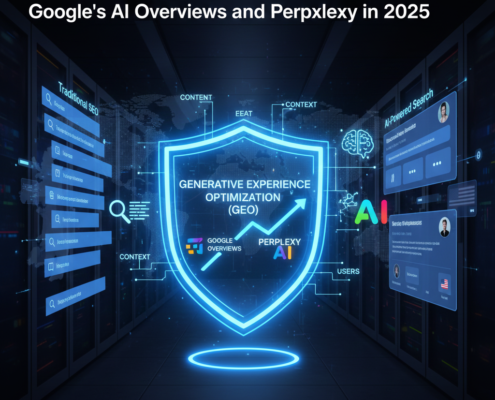
SEO is Shifting to GEO: How to Rank in Google’s AI Overviews and Perplexity in 2025
The search landscape is undergoing its most significant transformation in decades. For US and UK marketing managers, the burning question isn’t just “How do I rank #1 on Google?” but “How do I show up in Google’s AI-generated answers, Perplexity, or even ChatGPT?”
Welcome to the era of Generative Experience Optimization (GEO). The traditional SEO playbook, while still foundational, needs a serious update. Your audience isn’t just looking for blue links anymore; they’re looking for instant, synthesized answers from AI.
What is Generative Experience Optimization (GEO)?
GEO is the practice of optimizing your content to be accurately understood, summarized, and recommended by AI models that power search engines like Google’s AI Overviews (formerly SGE) and AI-first platforms like Perplexity. It’s about being the source that AI trusts and chooses to cite.
The Shift: From Links to Logic (and Back Again)
Historically, SEO focused heavily on keywords, backlinks, and technical site health. While these remain important, AI-powered search places a premium on:
- Semantic Understanding: AI doesn’t just match keywords; it understands the intent and context behind a query.
- Verifiable Information: AI models “hallucinate” less when they draw from high-quality, authoritative sources.
- Synthesizability: Can your content be easily summarized and integrated into a concise answer?
How to Rank in Google’s AI Overviews and Perplexity in 2025
For your UK and US clients, adapting to GEO means a strategic pivot in content creation:
1.Double Down on E-E-A-T (Experience, Expertise, Authoritativeness, Trustworthiness):
- Be the Expert: AI prioritizes content from verifiable experts. Showcase author bios, credentials, and real-world experience (the “E” for Experience).
- Cite Your Sources: For complex topics, clearly reference data, studies, and expert opinions. AI loves well-supported claims.
- Build Your Brand Authority: A strong, reputable brand is inherently more trustworthy to AI models.
2.Focus on Comprehensive, Yet Concise Answers:
- Answer the “People Also Ask” (PAA) Questions Directly: AI Overviews often draw from PAA-like structures. Look at what people are asking and provide clear, direct answers in your content.
- Structure for Summarization: Use clear headings, bullet points, numbered lists, and short paragraphs. Make it easy for AI to extract key takeaways.
- “What,” “Why,” and “How” Focus: Provide definitive answers to common questions within your niche.
3.Embrace Varied Content Formats:
- AI models are trained on diverse data. High-quality images, infographics, videos, and interactive elements can provide context and make your content more appealing to both users and AI.
- Ensure all multimedia is properly described with alt text and captions for AI comprehension.
4. Optimise for Long-Tail and Conversational Queries:
- AI search is naturally more conversational. Think about how a human would ask a question, not just a keyword phrase.
- Create content that addresses complex, multi-part questions that an AI assistant might synthesize.
5. Build a Strong Internal Linking Structure:
- Help AI (and users) understand the relationship between your content pieces. A robust internal link graph signals depth of knowledge and authority on a topic.
The Future is Now: Don’t Get Left Behind
The shift to GEO isn’t a distant future; it’s happening now. US and UK businesses that proactively adapt their content and SEO strategies to cater to AI-powered search will be the ones that dominate visibility. Those who cling to outdated methods risk becoming invisible.
It’s time to move beyond simply optimizing for keywords and start optimizing for true understanding and synthesis.
Ready to future-proof your visibility and ensure your business shows up in the AI-powered search results of tomorrow? Contact us for a GEO strategy session.